This article was written by longtime guild member Don Sinclaire for our original website in 2011. It’s reproduced here with light edits.
What’s in coal
The graph below shows the percentages of the main components of coal. Coal ranges from anthracite on the left to sub-bituminous and lignite on the right. I created the graph based on samples described in Alberta Research Council reports.
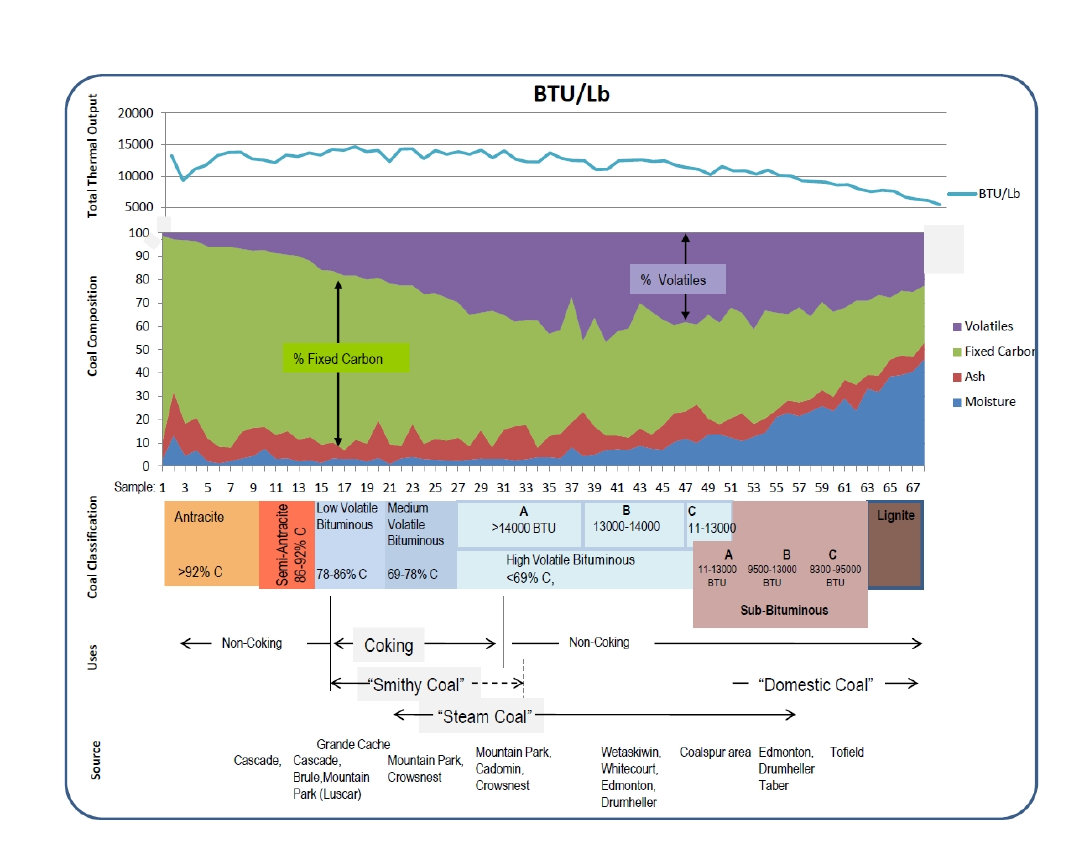
Click the chart to open it full size.
The main components are:
- Sulphur: 0.2–0.8%. It contributes to the smell of the coal fire, but is too small to show on the graph.
- Ash: typically 4 to 10%. It forms the clinker in the bottom of the fire pot. How bad the clinker gets depends not only on the percentage of ash, but also on how much coal you have to feed into the fire to get the heat you need.
- Moisture: this is the natural water in the coal as it’s found in the seam, not moisture added or removed later. Moisture content isn’t a big issue for smithing, since we water the coal down anyway, but it can be an indirect indicator of the volatiles in the coal and the grade of coal. High moisture gives coal a “poor storage” rating, since the lumps start to fall apart as it dries out, which also doesn’t matter to us. The only downside of moisture in coal is that you’re paying for it. A 400 pound barrel of domestic coal will have 100 pounds of water in it.
The remaining components are the ones that contribute to the heat output of the coal:
- Fixed carbon: pure carbon, which we burn as coke in the fire pot. This is our main source of heat.
- Volatiles: gases, oils and tar in the coal. These ignite at a lower temperature and help keep the fire burning. Anthracite, for example, has very little volatile material and will go out as soon as you stop the blower. In a power plant the volatiles add to the total heat output of the coal, but for smithing we burn off the volatiles in the coking process, and that heat goes up the chimney. Most of the heat we actually use comes from the fixed carbon.
What kind of coal we want
For smithing we want low to medium volatile bituminous coal. That gives enough volatile material to keep the fire burning, make the coal “sticky” so it forms lumps of coke, and make the coke porous. High volatile bituminous coal won’t coke, and even though it may have a high BTU per pound, a lot of that heat is lost up the chimney.
Where it is in Alberta
In Alberta, anthracite is found in the Cascade area near Banff. Low to medium volatile bituminous coal is found around Grande Cache, Cadomin (the Luscar mine) and the Crowsnest Pass. These areas produce “metallurgical coal,” which is what we want. Unfortunately, all of it is shipped out in unit trains, and they won’t sell it in small, truckload-sized quantities.
Even at Robb, which is fairly close to Cadomin, the coal is high volatile bituminous and sub-bituminous, and only suitable for heating. The Alberta Research Council maps show that as you go east of the Rockies, the moisture content (and volatiles) goes up quickly and the BTU per pound drops. There were no reports of any “metallurgical” or “smithy” coal anywhere on the Prairies.
The maps below are a bit hard to read, but they show how the coal grades fall off as you go east of the Rockies.
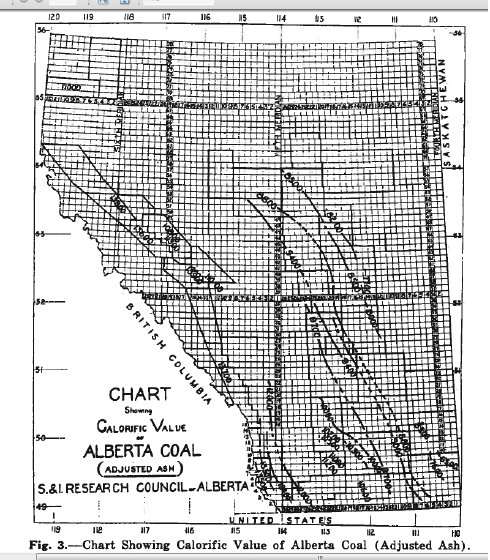 Calorific value of Alberta coal. From the Scientific and Industrial Research Council of Alberta, 1925.
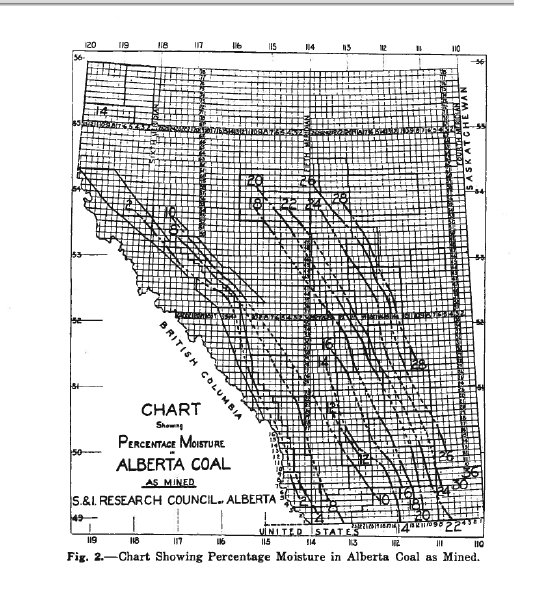 Percentage of moisture in Alberta coal as mined. From the Scientific and Industrial Research Council of Alberta, 1925.
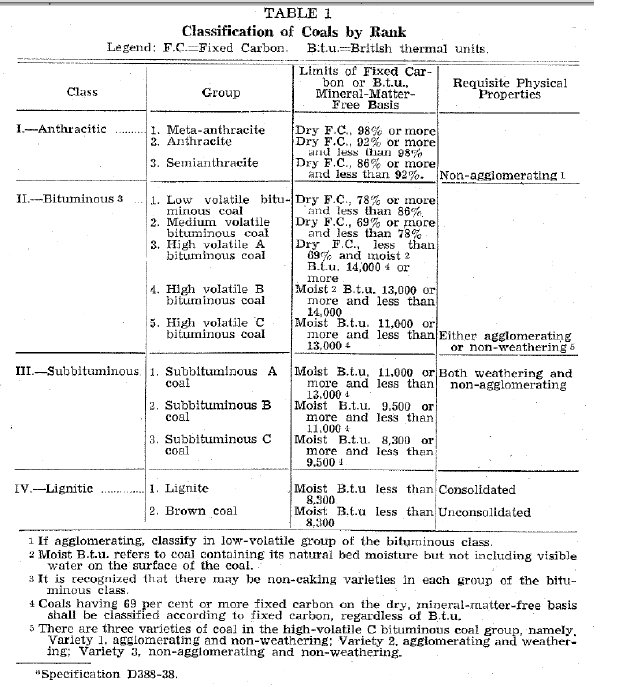 Classification of coals by rank. From the Research Council of Alberta, 1944.
Sources
- Analysis of Alberta Coal, Report #14, Scientific and Industrial Research Council of Alberta, 1925.
- Edgar Stansfield and W. Albert Lang, Coals of Alberta: Their Occurrence, Analysis and Utilization, Research Council of Alberta Report No. 35, 1944.
- Catalogue of Coal Mines of the Alberta Plains, Research Council of Alberta, 1964.
- D. Nikols and S. Treasure, Coal Quality Variation in Alberta Tertiary Coals, 1990.
- 2010 NI 43-101 Technical Report, Grande Cache Coal Corporation, 2010.
Article and chart © Don Sinclaire, 2011.