Safety Rules
For the safety of yourself, fellow smiths, and observers.
- Never forge coated or painted steel (zinc, galvanized, etc.). The fumes are toxic and can kill.
- Always wear PPE: safety glasses, closed-toe shoes (steel toe preferred), natural-fiber clothing and hearing protection.
- Assume all steel is hot. Hover your hand over it before touching.
- Let others know before forge welding or moving hot metal.
- Carry hot steel with tongs pointed down toward the floor.
- Cool hot cut-offs under the forge before throwing them out.
- Take steel out of the vices after cutting.
- Watch which way the sparks are going when grinding.
- Don’t strike the anvil face directly. Use the cut plates provided.
- Stay out of another smith’s space between their forge and anvil.
- We recommend a respirator or dust mask when grinding or working near fumes.
Why We Have These Rules
Most of the rules above are common sense once you’ve spent a few days at the forge, but a few of them come up a lot with new members, so here’s the reasoning behind them.
Zinc, galvanized and painted steel
Galvanized steel is coated in zinc, and zinc boils off at around 900°C. That’s cooler than a normal forging heat, so the coating turns to fumes almost as soon as the steel goes in the fire. Breathing zinc oxide fumes gives you what’s called metal fume fever: chills, fever, aches, and a nasty headache that feels a lot like the flu. A bad dose can do real damage, and people have died from it.
Paint is a gamble because you usually don’t know what’s in it. Older paints can have lead in them, some coatings contain cadmium, and even “safe” modern paint gives off toxic smoke when it burns. If a piece of steel is painted, plated or galvanized, grind or strip it back to bare metal outside the shop before it goes anywhere near a forge, or just leave it out.
Safety glasses
Things fly around at a forge. Scale (the black oxide skin on hot steel) pops off when you hit it and can come off red hot. Coal snaps and spits, grinders throw sparks, wire brushes shed bristles, and chunks can come off when cutting on the hardy. It only takes one piece in the eye, so glasses stay on the whole time you’re in the shop, even if you’re just watching.
Natural fibre clothing
Stick to natural fibres: cotton (including denim and canvas), wool, linen and hemp. Leather is great too, which is why so many smiths wear leather aprons. Synthetics like polyester, nylon, acrylic and fleece melt when a spark or a hot piece of scale lands on them, and the melted plastic sticks to your skin and keeps burning. Cotton will scorch or get a small hole in it, and wool is naturally fire resistant. Check your hoodie and base layers too. A lot of “cotton” clothing is actually a poly blend.
Respirators
Our forges burn real coal, and coal isn’t clean. Along with the smoke and fine ash, coal smoke carries sulphur, which is where that sharp, sour smell in the shop comes from, plus trace amounts of arsenic and other impurities depending on the coal. Our extraction fans pull most of it out, but some always hangs in the air on a busy shop day. Grinding throws fine metal and abrasive dust as well. A good half-mask respirator with particulate filters (P100) makes a big difference, especially if you’re at the shop often. Keep in mind a dust mask doesn’t stop carbon monoxide, so the fans still need to be running.
Why gloves aren’t on the list
You might expect gloves to be required, but a lot of smiths don’t wear them, and we leave it up to you. On the hammer hand, a glove makes it harder to grip the handle and feel what the hammer is doing, so you end up squeezing the handle too hard, which leads to a sore wrist and elbow and sloppy blows. Gloves can also give you a false sense of safety. If you pick up hot steel with a glove on, it doesn’t feel hot right away, so you keep holding it while the leather heats up, and then you can’t get the glove off fast enough. Bare hands tell you straight away and you let go. Synthetic gloves are worse because they melt onto your skin.
They’re also a real hazard around anything that spins. A glove can get caught in a drill press, a wire wheel or a belt grinder and pull your hand in with it, so take them off before using any of those.
Plenty of people like a leather glove on their tong hand, especially when working at the forge for a while, and that’s fine. Just make sure it’s leather, it fits well, and you still treat every piece of steel like it’s hot.
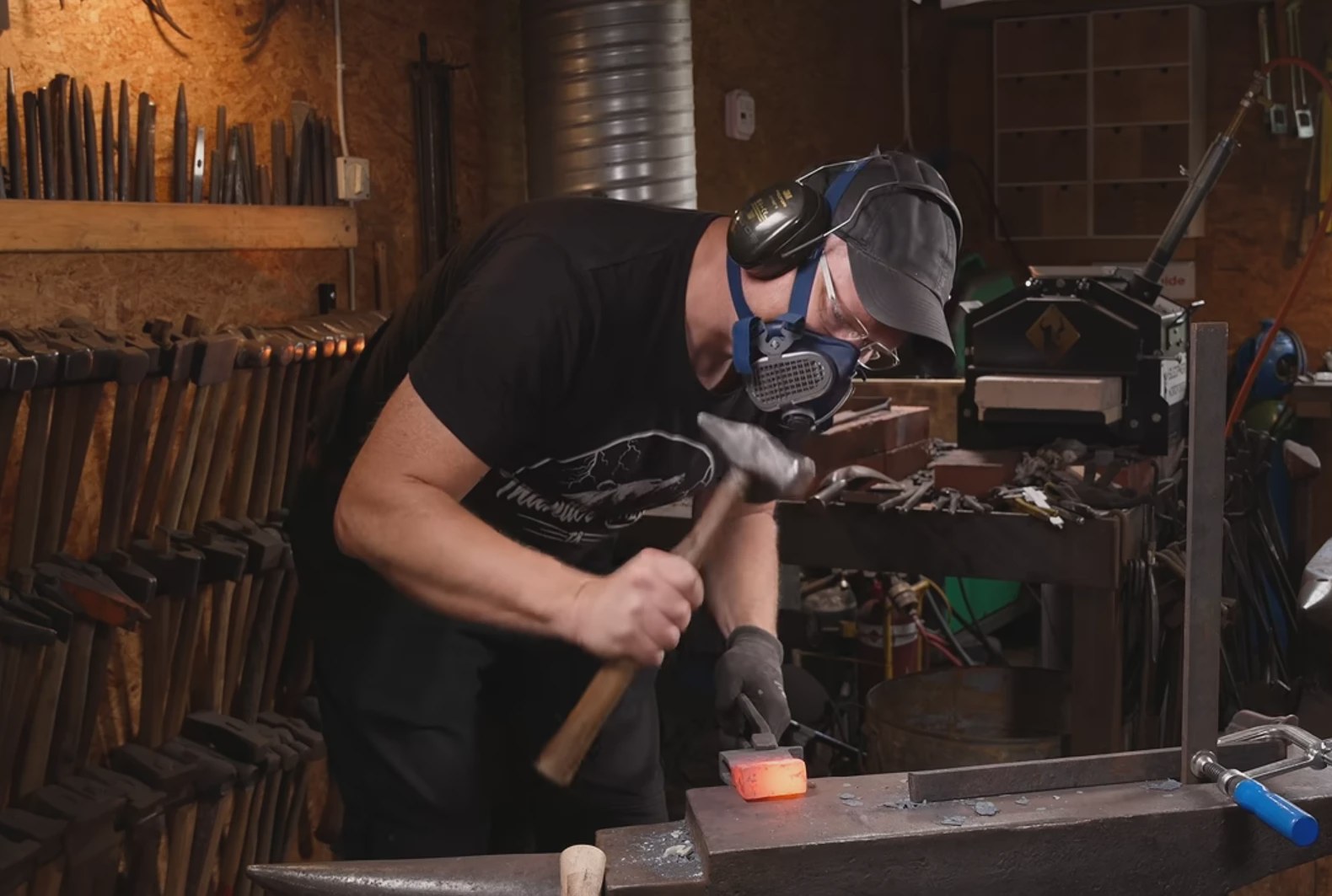 Swedish blacksmith Torbjörn Åhman at work in his shop, with safety glasses, hearing protection and a respirator. Image used with permission. See more of his work at torbjornahman.se.
Shop Etiquette
To keep the shop organized, tools in good condition, and workspaces ready for everyone.
- Put all tools back where they belong after use.
- Don’t cut directly on the anvils. Always use a cut plate.
- Keep work surfaces clear of clutter.
- Label your personal tools and belongings.
- New or donated tools and material must be given a permanent place by the shop director or board.
Closing Checklist
Before leaving, make sure the shop is clean, secure, and ready for the next smith.
Tools
- Put all tools away:
- Hammers → hammer rack
- Files/rasps → file box
- Pegboard tools → wall
- Chisels/punches → bucket area
- Tongs → wall rack (not the forge racks)
Forges & Stations
- Each forge station needs: scoop, poker, wire brush, dipper, slack pail, coal pail, cut plate, hot cut hardy and ashpan.
- Break apart the coal hearths and let them cool fully.
- Empty the slack pails and wet the coal (Oct–Mar).
- Turn off the propane tanks and move them outside.
Shop & Building
- Turn off the lights and extraction fans.
- Close and lock all four doors, the windows and the viewing doors.
- Shut off the park water hoses at the spigot (if used).
- Latch the bathroom doors and turn off the lights.
- Clear picnic tables and pails off the grass in front of the building.
- Do a final walkthrough of the shop.
- Return the key to the lock box.
Click here to view or print the shop rules and closing checklist (PDF).